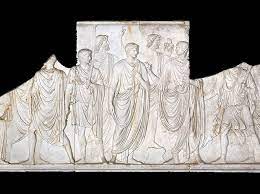
The conflict broke out following the Dacian attack on the Danube in Moesia in late 85. Oppius Sabinus' army was destroyed and the provincial governor was killed. The news of the defeat prompted the emperor Titus Flavius Domitianus to launch an expedition against the Dacians, to replace the lost legion and strengthen the Roman army in this section.
The emperor stopped at Naissus where he organized parties and banquets. He sent Cornelius Fuscus against the Dacians, who was an adventurous man who loved danger. Negotiations took place in order to avoid a confrontation, the Dacians demanding peace in exchange for a sum of two oboli paid by any Roman in the empire. Fuscus' expedition failed , the Roman general being killed in battle, and the V Alaudae legion being annihilated in the First Battle of Tapae in 87. The Dacians captured the flags and machine guns. Roman novels. After this victory, the Dacian king Diurpaneus received the nickname of Decebalus , meaning "the brave" or "the strong".
In 88, Domitian realized the power of his opponent and sent an army led by Tettius Iulianus. The Romans crossed the Danube at Viminacium and entered Transylvania from Banat. The Romans gain a victory in the First Battle of Tapae. According to Cassius Dio, Decebalus resorted to a ploy, cutting down the trees of an entire forest, dressing them in the clothes of soldiers to make the Romans believe that he had great strength. The Romans and the Dacians made peace after Domitian suffered defeats and losses in the confrontations with the Quasi and the Marcomanians, who supported the Dacians. Decebalus made a favorable peace with Domitian in 89, Dacia becoming a client kingdom of Rome , receiving craftsmen, builders, military instructors and money to defend the borders of the empire. Some historians believe that this unfavorable peace for the Romans provoked Domitian in September 96 .
Decebalus, instead of using the money as the Romans wanted, decided to start building new fortresses in the mountains, in important strategic points, and to strengthen the existing ones. Receiving grants in money and engineers, Decebalus recognized himself as the client king of Rome, consolidating the kingdom for 12 years. The process of centralizing the Dacian state has accelerated, with the army being equipped and trained. An extensive civil and military construction program has been initiated in the Orăștie Mountains region. Relations were established with populations and states hostile to Rome. After Domitian's death, Nerva is appointed emperor, trying to restore the prestige of the senate. He was succeeded by Marcus Ulpius Nerva Traianus under whose rule the empire reached its maximum territorial extent. Trajan considers the peace concluded in 89 to be shameful and therefore decides to start a new war.
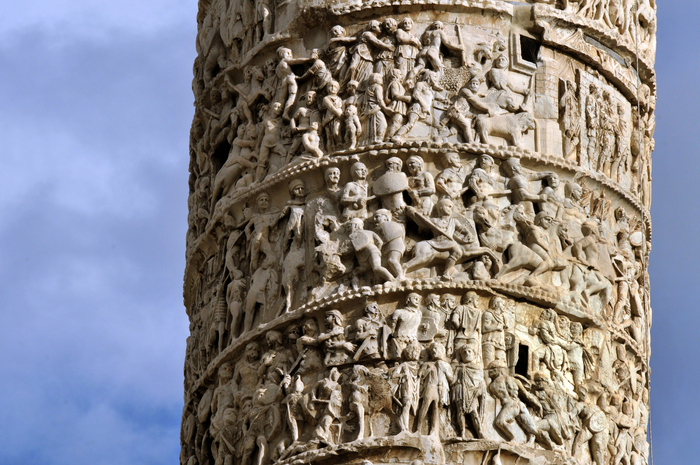
In the spring of 105 the emperor crossed the Danube at Viminacium following the route taken by Tettius Iulianus. The Romans defeat the Dacians at the Second Battle of Tapae. Trajan's Bridge was a bridge built by Apollodorus of Damascus, the architect of the Column, between the spring of 103 and the spring of 105 on the Lower Danube, east of the Iron Gates, in the town of Drobeta-Turnu Severin. The purpose of the construction was to facilitate the transport of Roman troops led by Trajan and the supplies needed for the second military campaign to conquer Dacia from King Decebalus. At Drobeta between the 2 Dacian wars, Apollodorus builds a bridge of 1.1 km for the Roman Empire to succeed in crossing the troubled waters. Engineer E. Dupex rebuilt the bridge in 1907.