
The origin of the Romanian language is strictly related to the process of formation of the Romanian people, therefore, we can consider it as controversial. From a linguistic point of view, it is certain that the Romanian language comes from the Romanization of the ancient populations of the lower Danube basin which, as Herodotus and other ancient authors tell us, were Thracian-Dacian peoples, and later this language was influenced by Slavic, Greek, Hungarian and other languages. This is the point from which various theories regarding the Romanian ethnogenesis were born, therefore, with reference to the formation of the Romanian language. The controversies concern not only the linguistic process and its stages, but also the territories where this process took place and their extent. Maria Cvansîi Cătănescu states in “The Romanian Language. Origins and Development ”that“ Today it is generally accepted that the ancient history of the Romanians is the expression of a major process, of Daco-Roman synthesis, and of an adjacent process, of integration and assimilation of the migratory element ”.
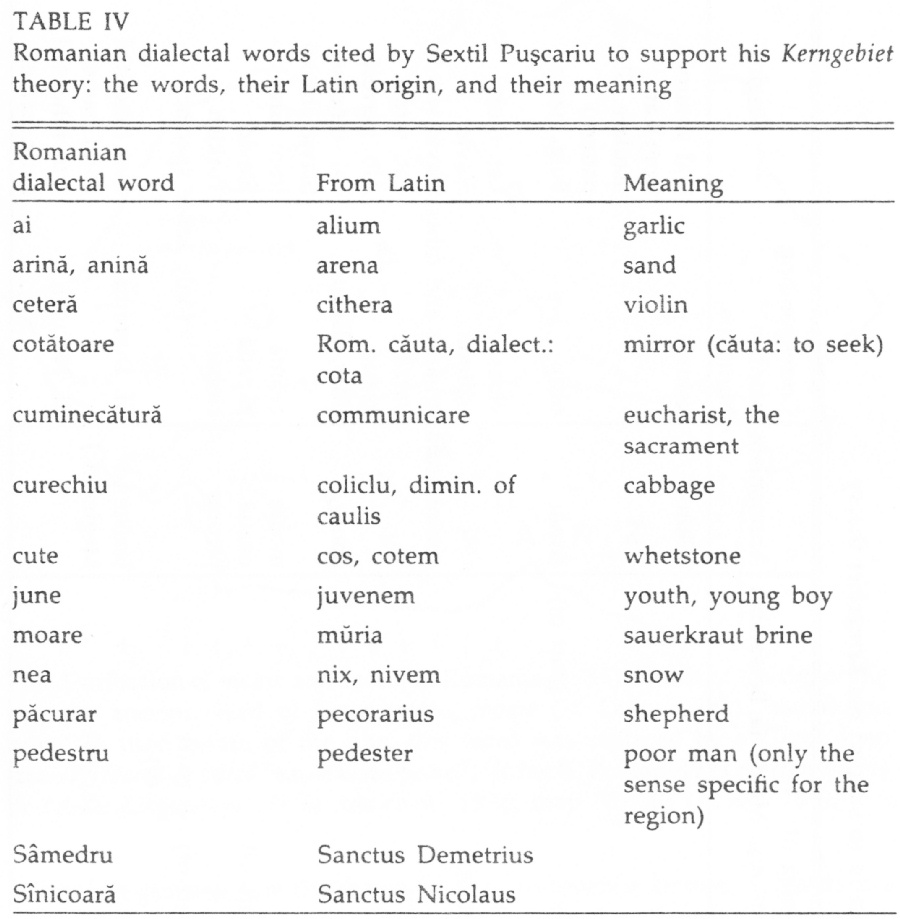
The Theory of Continuity in Dacia and Moesia argues that the original nucleus of the Romanian language, and therefore of Romanian ethnogenesis, was in both the north and south of the Danube (in an area comprising Dacia and Moesia) while the free Dacians migrated to the Balkans driven away by the invasions of the Goths, Huns and Slavs, ultimately constituting the Albanian people, and thus explaining the common words between the Albanian and Romanian languages. The invasion of the Slavs and the fierce Byzantine war against the Bulgarians during the reign of Emperor Basil II Bulgarohton finally separated the Romanians from the north of the Danube from the southern Aromanians, who left Moesia to take refuge in the Pindus Mountains and Thessaly.
The Theory of Relocation from the Balkans to Dacia starts, on the other hand, from the accounts of Eutropius (who states that all the inhabitants of Dacia were transferred to the south of the Danube when the Romans withdrew) and from the writings of Eduard Robert Rösler, who considers that geographical proximity in the Balkans explains why there are common words between Albanian and Romanian, and concludes that the original nucleus of the Romanian language must be sought in present-day Macedonia, where subsequent migrations the Vlachs were brought to the north of the Danube, at the call of the Hungarian kings, to populate Transylvania, which had hitherto been in vain. Linguists in Austria and Hungary are in favor of this hypothesis, as it is in line with the official theories of these countries that there were no Romance populations in Transylvania at the time of the arrival of the Hungarians. In this theory, the Aromanian language is the closest to the original form of the Romanian language.
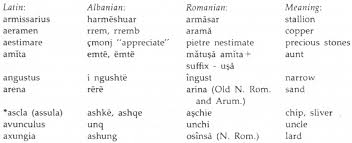
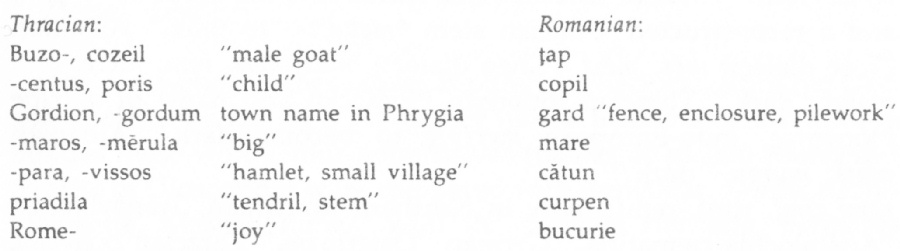
The most widespread theory, however, among contemporary Romanian historians is that derived from the theory of the definitive and steadfast Romanization of Dacia. According to this variant, the Roman Empire colonized Dacia in a very short period of time with a representative mass of settlers from all over the Empire, but especially from Latin culture (approximately 80%). The arguments for this intensive colonization are particularly related to the strength of the Dacian defense, which, according to Latin sources, threw into battle almost the entire male population of the province, leaving behind a war a decimated population. This resulted in a tiny representation of the Geto-Dacian names in the remaining inscriptions (approximately 4,000 inscriptions were studied, of which only 2% contained Geto-Dacian names, compared to about 30% as a representation of the native population in other provinces). Romanized). Following this unusual colonization of a Roman province (this phenomenon had never happened in the Empire), the original language of the province, the language if, it would have disappeared, at least a few words kept in the current baggage of the Romanian language. An approximation would be about 89 sure words.
What is certain is that the Latin language settled in the new province with the administration and the Roman army. As in the other conquered provinces, in the first phase, the Dacians were forced by the practical needs of life to adopt Latin as a secondary language, using it in their relations with the administration, the army and the Roman colonists. It is known from the Latin scriptures that in Gaul, for example, those who first adopted Latin were the nobles and merchants. The first ones sent their children to Roman schools because only in this way could they be promoted to the magistracy of the Empire. The merchants were also interested in learning it, because Latin was the language of commerce throughout the Empire.
In the second phase, Latin became the main means of communication; the old populations abandoned their mother tongue, the scope of which was becoming more and more restricted (it was probably still used as a language of conversation in the family). This process of adopting the Latin language and leaving the mother tongue is called Romanization and took place in all the regions conquered by the Romans. The Romanian language, like any other language, is constantly changing. Similarly, there is talk of the Latin language, which, arriving in its time in various parts of the Empire, was slowly changed by people, who thought that a certain word might be relatively complicated to pronounce as it was. Thus appeared vulgar Latin, which does not refer to obscenity, but to the fact that it was spoken by the people, not being cared for or adopted in writing. In time, because the changes took place differently depending on the geographical areas, after the collapse of the Empire (4th century), vulgar Latin developed into varieties that became, over time, the Romance languages.
Addressing a grammatical problem, in comparison with the other Romance languages, we will refer to the use of the decidedly enclitic article. In French, translating the word "girl" from Romanian, we will get "la fille", being able to observe how the definite article remains in front of the noun. This is closely related to the way in Latin we would refer to "that girl", "that" being the demonstrative article which, depending on the gender, becomes "ale", "ila" and "ilud" in Latin, " le ”and“ la ”in French (the neutral is lost) or“ el ”,“ la ”and“ lo ”in Spanish. What attracts the attention of linguists is that the Romanian language retains the root of the same demonstrative article, but it moves to the end of the word and changes. We get the "girl" in the first phase, and later, due to the simplification, the "girl". The reason for this is precisely that the Slavic languages also use the enclitic article at the end of the word, even if it certainly does not derive it from a Latin root; the Slavic influence on the Romanian language is of the greatest importance, this taking place with the migration of the Slavs on the territories south of the Danube, somewhere in the middle of the 6th century.
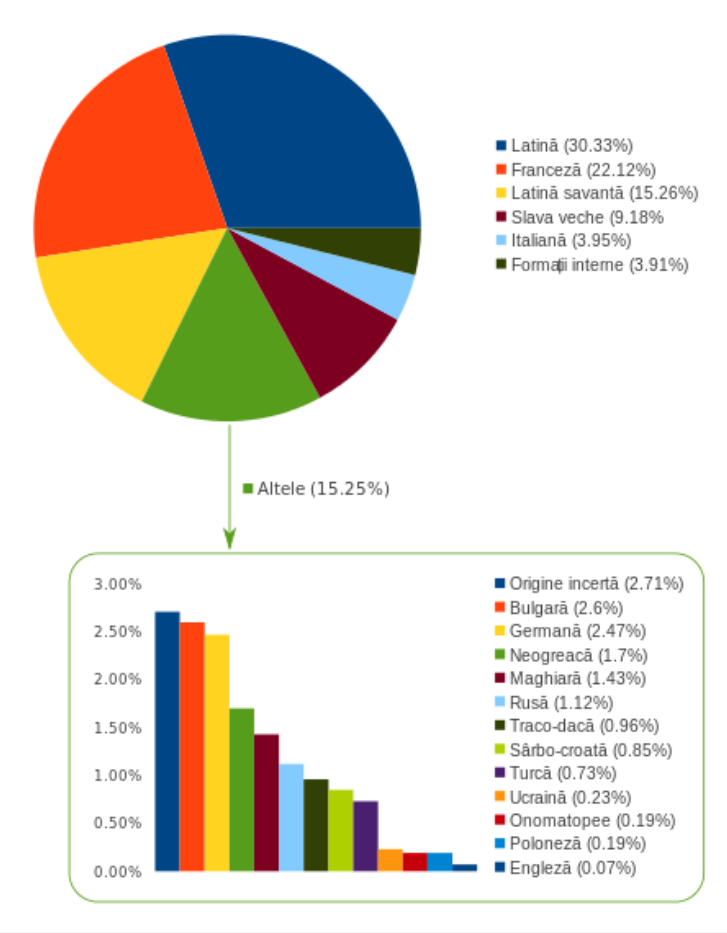
The Slavic lexicon contains mostly common nouns, which refer to man and family , house, household items and tools , flora and fauna , elements of nature , church terms , abstract notions ; we also find proper nouns, names of people or places. Also, some verbs, adjectives, as well as many of the suffixes are of Slavic origin. However, the Romanian language remains about 70% Latin, even if only a third of the vocabulary is inherited directly. The rest come from French, Italian or scientific Latin, and were borrowed back into Romanian. This is called the relatinization process and took place in the 19th century. It has been estimated that approximately 38% of Romanian words are of French or Italian origin.
For about one hundred and fifty years, many words borrowed from English have entered the language, such as “jam” (from “jam”), “interviu” (“interview”), "Match", "tram", "manager". These words receive a grammatical gender and are given according to the rules of the Romanian language. However, since about 1990, English words, despite the recommendations of the Romanian Academy and the "Pruteanu law", no longer enrich the Romanian language by receiving grammatical gender and tuned according to the rules of the language, but are used by the media and the Romanian population. in its original form, as in mostly unwritten languages, such as "mall," "service," "computer," "forward," or "attach." who misjudges the adoption of words in Romanian forms as archaic.
A few words of Latin origin entered the Romanian language twice, once in the lexical nucleus (in the popular vocabulary) and later as neologisms. Usually the popular word is a noun, and the neologism is an adjective.