Relation with Eminescu
Mihai Eminescu and Ion Luca Caragiale met in their youth, attracted by their passion for theatre. Best friends and colleagues at the newspaper "Timpul", the two ended up hating each other because of a woman the poet wanted to marry.
The friendship between Ion Luca Caragiale and Mihai Eminescu
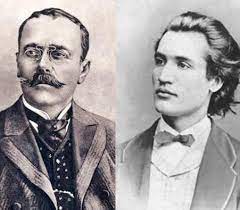
Mihai Eminescu and Ion Luca Caragiale met when the poet was co-opted into the theatre company of Costache Caragiale, Ion Luca's uncle. The two became friends and it is said that they were inseparable for a year. Caragiale admired Eminescu and said of him that "He was unnaturally beautiful... Too beautiful to be true".
In turn, Eminescu considered Caragiale: "A true dandy. Well-dressed, elegant and with a great knowledge of literature, but also a great lover of theatre". After Eminescu left to study in Vienna, the two friends parted ways. They found each other again a few years later, after Eminescu returned to the country and they became colleagues in the editorial staff of the newspaper "Timpul" in Bucharest and at Junimea.
It was Eminescu who advocated Caragiale's employment at "Timpul". "There is no man in Bucharest more capable of journalism and art than I. L. Caragiale!", the poet is said to have said of his friend, according to B. Jordan and Lucian Predescu, authors of "Tragic Destiny of a Writer", published in 1939.
The long days of editorial work ended in the evening in the city, over a carafe of wine. In their discussions, the two friends touched on a wide range of subjects, from art to philosophy and literature to women. This is how Caragiale seems to have learned about Eminescu's love for Veronica Micle.
Betrayal of Caragiale's good friend
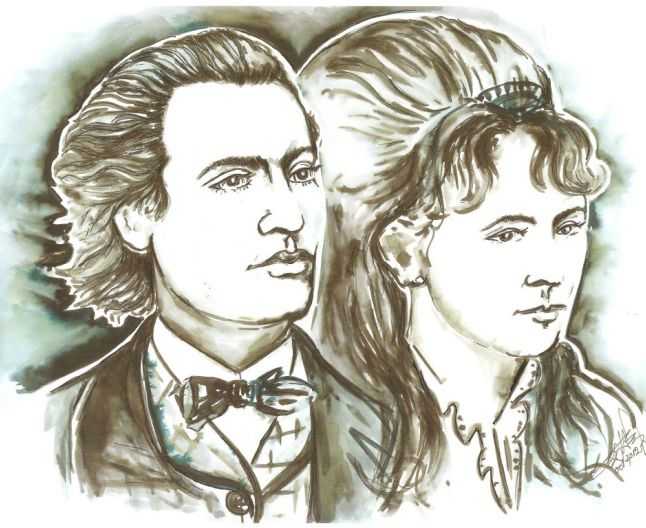
Caragiale left the editorial office of the newspaper "Timpul" in 1878 and went to "Junimea" in Iasi, directed by Titu Maiorescu. When he arrived in Iași, he met Eminescu's lover Veronica Micle, and a secret love affair developed between the two. Eminescu, who remained editor of the newspaper "Timpul", rarely came to Iasi and the relationship with Veronica was more through love letters. Eminescu's blond passion fell into the arms of the phlegmatic Caragiale, without the poet who remained in Bucharest suspecting anything.
Eminescu finally learned of his good friend's affair with his beloved Veronica from Maiorescu himself. When he went to tell the critic that he was thinking of marrying her, the latter revealed his lover's infidelity: "Eminescule, forgive me, please, for the heartbreak I know I am causing you, but the one you have chosen as your life companion does not deserve this honour, she does not deserve it! Before you she was a friend of others, she was Caragiale's. He told me so himself". "Canalia!" was all the poet could say to his friend who had betrayed him after learning of Veronique's infidelity.
Eminescu threatened him with a duel
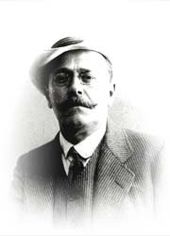
After learning of the infidelity, Eminescu threatens Caragiale with a duel, but the two do not come to a physical confrontation. The poet forgave his unfaithful lover, but not his betraying friend. "The gentleman in question I have brushed off in society, but he has kept quiet like the worthless man he is. I have consulted a man of business acquaintance what I must do to ask for your letters. He told me you must ask him for them. In case he would not give them, for he is free not to do so, I can compel him to give me satisfaction. Please ask him for the letters and then answer me whether he has sent them or not. Doubt no more that he is of absolute bad faith. He is a man who cannot be otherwise", Eminescu wrote to Veronique after the resumption of the relationship, concerned about the intimate details of the treacherous relationship that Caragiale might have revealed. The only meetings between Veronica and Caragiale, after the infidelity was discovered, were only occasions for accusations and reproaches.
The impact
When Eminescu was struck by illness and showed the first signs of madness, his former friend's reaction was to burst into tears at the news. The scene in which Caragiale learned of his friend's first bout of insanity in his youth was recounted by Titu Maiorescu in his Diary: "Sunday, July 26, 1883. Eminescu goes mad. He blessed Mrs. Maiorescu and Miss Livia with his eyes fixed on the wall, he held Mr. Maiorescu in his arms, trembling with all his strength. Then Caragiale came to our house for lunch, and when he heard about Eminescu, he began to cry".