Ion Luca Caragiale
Ion Luca Caragiale (1 February 1852 Haimanale, Prahova County, Wallachia, today I. L. Caragiale, Dâmbovița County, Romania - 9 June 1912, Berlin, German Empire) was a Romanian playwright, novelist, pamphleteer, poet, writer, theatre director, political commentator and journalist. George Călinescu considered him to be the greatest Romanian playwright and one of the most important Romanian writers. He was elected post-mortem member of the Romanian Academy.
His Life
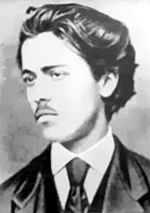
He was born on 1 February 1852 in the village of Haimanale (which today bears his name), the first child of Luca Stefan Caragiale and Ecaterina Chiriac Karaboas. According to some sources, his family was of Aromanian origin. His father, Luca (1812 - 1870), and his brothers, Costache and Iorgu, were born in Constantinople, the sons of Ștefan, a cook employed at the end of 1812 by Ioan Vodă Caragea in his retinue.
Attracted by the theatre, Luca married the actress and singer Caloropoulos in 1839, from whom he separated, without ever divorcing, and founded a stable family with Ecaterina from Brasov, daughter of the Greek merchant Luca Chiriac Karaboas.
He did his first studies in 1859 and 1860 with Father Marinache, from the Church of St. George in Ploiesti, and until 1864 he attended primary classes II-V, at the Domnească School in Ploiesti, where his teacher was Bazil Drăgoșescu. Until 1867 he attended three classes at the "Sfinții Petru e Pavel" Gymnasium in Ploiești, and in 1868 he finished the 5th grade of high school in Bucharest. Caragiale graduated from the "Sfinții Petru e Pavel" Gymnasium in Ploiești, which he named in the Grand Hôtel "Victoria Română", his hometown. The only teacher whom the author of Moments remembered with gratitude was Bazil Drăgoșescu from Ardele, the one who in his memoir After 50 Years received the ruler of the Union in his class.
Berlin exilation
Caragiale was accused of plagiarising The Plague from a play by the Hungarian writer István Kemény, entitled "The Fool". The accusation appeared in 1901 in two articles in the Literary Review, signed under the pseudonym Caion. Furious, Caragiale turned to the Bucharest press, found out the author's real name (C. Al. Ionescu), took him to court and won without any problems, thanks to the pleadings of his lawyer, Barbu Ștefănescu Delavrancea.
The 12 jurors, however, decided to acquit Caion, the whole scandal being labelled "a child's impertinence"
Strongly supported by Alexandru Macedonski, also allergic to values, Caion "discovers" another "two plagiarisms". Disgusted by his humiliation and fed up with injustice, Caragiale decided to leave the country, moving with his family to Berlin in 1904, when he received a long-awaited and disputed inheritance from his aunt, Ecaterina Cardini from Șcheii Brașov (known as Mumuloaia, after her husband's nickname Momulo), whose real estate business had brought her great wealth.
Giving up the silence he had imposed on himself during his voluntary exile in Berlin, the events of the spring of 1907 led Caragiale to publish, in November 1907, in Bucharest, the pamphlet 1907 from spring to autumn, a famous essay on the causes and development of the great peasant movement of the spring of 1907. Before publishing his pamphlet in the booklet, Caragiale had sent the first chapter to the Viennese newspaper Die Zeit, the first and most important part of the future booklet, which published it on 3 April 1907, with his signature: A Romanian Patriot, showing all that happened before and after the outbreak of the peasant revolt in the spring of 1907: "The cause of the disaster into which the country has fallen is only - yes, only, the wretched policy that our parties and statesmen have been making for forty years now.
Critics appreciations
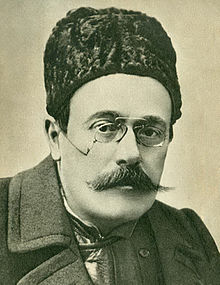
Caragiale is portrayed as a fierce defender of his writing, fighting with publishers to make them respect his full text, spelling and punctuation. His impeccable artist's conscience and scrupulousness are testified to in his numerous letters to friends, to whom he reproaches "the sauce of spelling and punctuation mistakes" and "enormous fundamental errors". Sică Alexandrescu proposed a correct printing, based on a text that would be scientifically compared with the Socec and Saraga editions and Caragiale's manuscripts, "a text in which the spelling of the great writer would be restored to its rightful place, taking into account, rigorously, consistently, but with great discernment, the latest established academic rules".
A. E. Baconski sketches some "similarities and neighbours" between Caragiale and Tudor Arghezi. In both of them the same patriotism is evident, the same target of satire, hitting the professional categories with a spoial of culture, with a Frenchified jargon. Baconski notes in both "the passion for style, for a certain stylistic architecture, simpler in Caragiale, more scholarly in Arghezi".
Nicolae Steinhardt noted in his essay, The Secret of the Lost Letter, that Caragiale's work was read from two perspectives until 1975. The "leftist" perspective (represented by Alexandru Piru and Ovid S. Crohmălniceanu) was characterized by the overemphasis on the criticism of the Romanian bourgeoisie, considered the Romanian "right", its vices and its political regime, and the "nationalist" perspective, represented by N. Grigorescu, Nicolae Iorga, Lovinescu, N. Davidescu, who blamed the writer for his alleged hatred of his countrymen. Nicolae Steinhardt introduced a third perspective, that of a deeply Christian Caragiale, the creator of a world in which the general atmosphere... is gentleness, the pillar of Christianity.