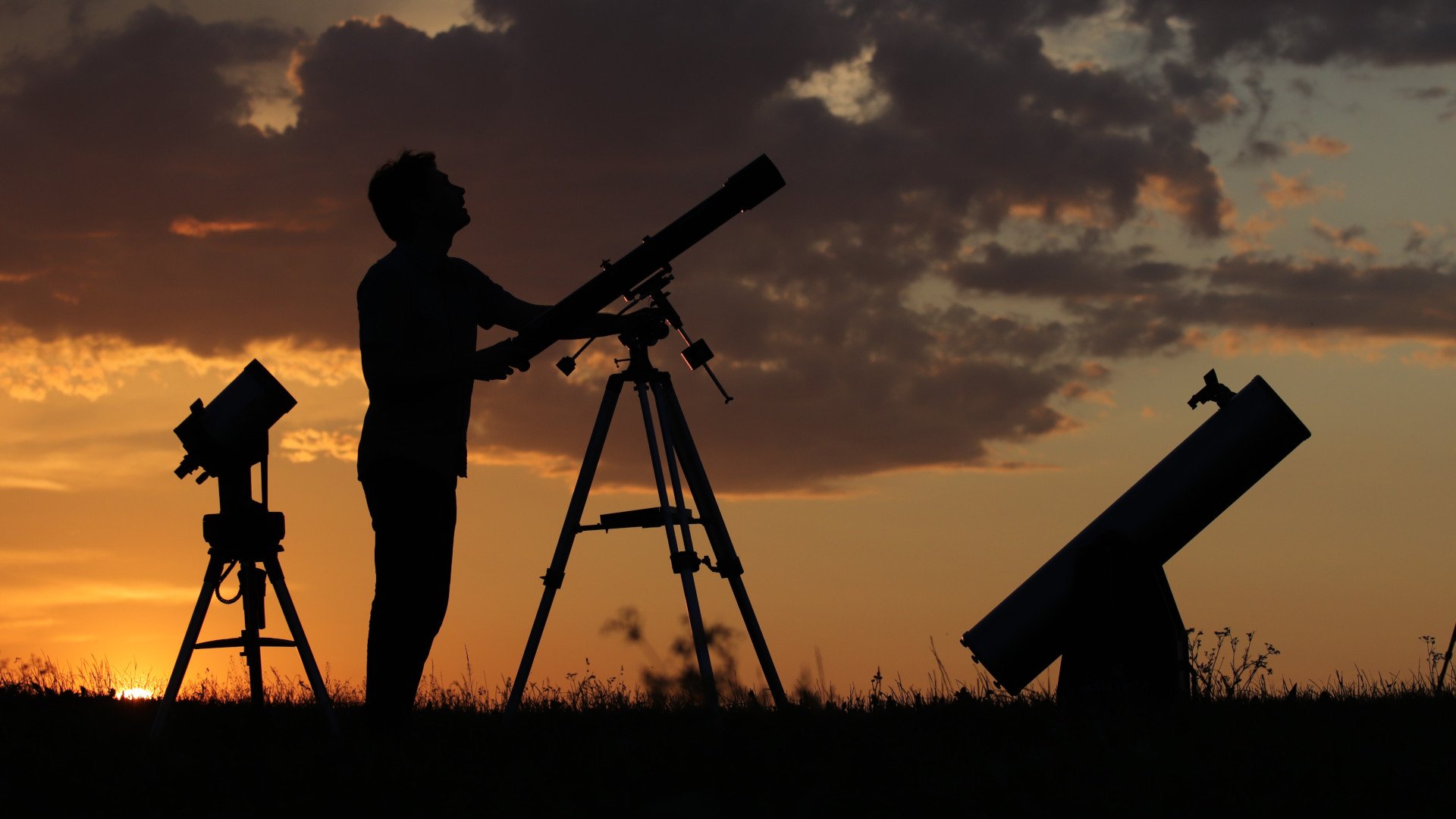
Astronomy is a natural science that studies celestial objects and phenomena. It uses mathematics, physics, and chemistry in order to explain their origin and evolution. Objects of interest include planets, moons, stars, nebulae, galaxies, and comets. Relevant phenomena include supernova explosions, gamma ray bursts, quasars, blazars, pulsars, and cosmic microwave background radiation. More generally, astronomy studies everything that originates beyond Earth's atmosphere.
Astronomy means "law of the stars" (or "culture of the stars" depending on the translation). Astronomy should not be confused with astrology, the belief system which claims that human affairs are correlated with the positions of celestial objects. Although the two fields share a common origin, they are now entirely distinct.
"Astronomy" and "astrophysics" are synonyms. Based on strict dictionary definitions, "astronomy" refers to "the study of objects and matter outside the Earth's atmosphere and of their physical and chemical properties," while "astrophysics" refers to the branch of astronomy dealing with "the behavior, physical properties, and dynamic processes of celestial objects and phenomena". Since most modern astronomical research deals with subjects related to physics, modern astronomy could actually be called astrophysics. Some fields, such as astrometry, are purely astronomy rather than also astrophysics.
No area of science is totally self-contained. Discoveries in one area find applications in others, often unpredictably. Various notable examples of this involve astronomical studies. Isaac Newton’s laws of motion and gravity emerged from the analysis of planetary and lunar orbits. Observations during the 1919 solar eclipse provided dramatic confirmation of Albert Einstein’s general theory of relativity, which gained further support with the discovery of the binary pulsar designated PSR 1913+16 and the observation of gravity waves from merging black holes and neutron stars. The behaviour of nuclear matter and of some elementary particles is now better understood as a result of measurements of neutron stars and the cosmological helium abundance, respectively.
Astronomical knowledge also has had a broad impact beyond science. The earliest calendars were based on astronomical observations of the cycles of repeated solar and lunar positions. Also, for centuries, familiarity with the positions and apparent motions of the stars through the seasons enabled sea voyagers to navigate with moderate accuracy. Perhaps the single greatest effect that astronomical studies have had on our modern society has been in molding its perceptions and opinions. Our conceptions of the cosmos and our place in it, our perceptions of space and time, and the development of the systematic pursuit of knowledge known as the scientific method have been profoundly influenced by astronomical observations. In addition, the power of science to provide the basis for accurate predictions of such phenomena as eclipses and the positions of the planets and later, so dramatically, of comets has shaped an attitude toward science that remains an important social force today.