Varegi is the name under which the Vikings were known to the Greeks and Eastern Slavs.
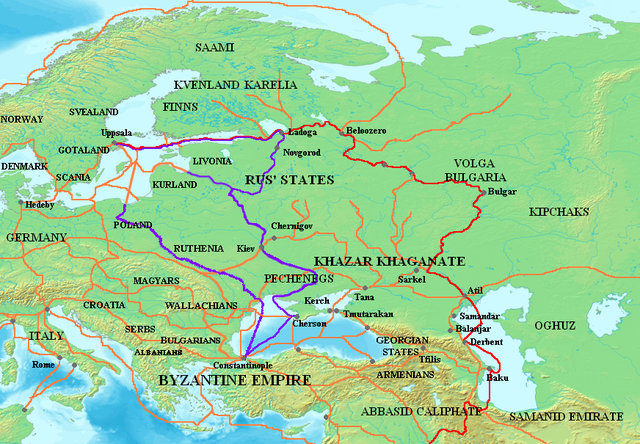
The Varangians made frequent incursions into Constantinople, for trade or prey, using boats built from a tree trunk, and using the courses of the Dnieper and Dniester rivers.
Constantin Porfirogenetul mentioned that from the mouth of these rivers, the Varangians sailed only by the sea, making stops at Aspron (White Fortress) and then at Sulina being closely watched by the Pechenegs.
At each stop, the Varangians disembarked and guarded against the attacks of the Pechenegs.
After Sulina, they stopped at Conopa (near Lake Razelm), Constanța and Varna.
It follows that the road from Varangians to Greeks had stops in present-day Dobrogea.
The Varangians crossed the territory of Dobrogea during their expeditions against the Byzantine Empire in 968.
The small churches excavated in the chalk massif from Basarabi-Murfatlar date from the 9th century.
Among the inscriptions and drawings from Basarabi-Murfatlar are symbols, dragons and ships of the Varangians.
Victor Spinei (historian) wrote about the battle of the Alta River (near Kiev) in 1019, noting that the Romanians ("blokumenn" as they were called) and the Pechenegs fought against an alliance that included the Varangians.
Florin Curta also wrote about this confrontation.
It was the only remaining confrontation in documents between Romanians and Varangians.
A memorial stone on the island of Gotland in the 11th-century town of Sjonhem mentions that Rodfos, a Viking chief, was killed by a "blakumen while traveling abroad."
Most likely the event took place in the eastern Carpathians on the road along the Dniester from the Varangians to the Greeks.
In 1025, the strategist Boioannes was ordered to prepare for the recapture of Sicily. The campaign was conceived and coordinated by Emperor Basil II.
The emperor assembles the empire's army and sends it to Italy.
The Balkan Romanians and the Varangians were also part of this multinational army.
The participation of Romanians (Wallachians) and Varangians in the campaign is reported in the chronicle "Anales Lupi Protospatharii" also called "Annals of Bari".
The Varangians and Cumans played an important role in driving the Uses out of the territories between the Dniester and the Carpathians in 1060, south of the Danube into the Roman Empire.
In a twelfth-century saga, The Miracle of Saint Olaf, the Blokumannaland or Wallachian land is mentioned.
Near the locality of Nufăru (former Prislav, Tulcea County) were identified the ruins of a fortified settlement which was for a short time (968–971) the residence of the Varangians led by Sveinald (Sviatoslav in the Chronicle of Nestor) son of Ingvar (Igor) In archeological excavations wooden structures specific to the constructions of the northern populations were found near Nufăru
Near Brăila there was a small fortress called Chiovița (or Kiovița), also mentioned in Nestor's Chronicle which dates from the time of the Varangian incursions. Today, only the name Valea Chioveanul remains in the local toponymy.
Lozovan also confirmed G.I. Brătianu, that in the north of Moldova (Șipeniț or Onut) there was a Romanian political party before the founding of Moldova and probably under the influence of the Varangians. In Vasileu, in the former country of Onut (today in Ukraine) there are the remains of a church that had a tomb with a slab of the founders with Viking signs and runes.
The sarcophagi found in the same area belong to the descendants of Christianized and Slavicized Vikings (12th century).
Archaeological excavations in Romania have brought to light various objects that belonged to the Varangians, in the localities of Păcuiul lui Soare, Dinogeția (Garvăn), Isaccea and Nufăru.
A fragment of a Viking sword was discovered at Păcuiul lui Soare. Three Viking swords found in Dobrogea are on display at the Archaeological Museum in Constanța.
The word "fair" came from the Varangians in Romanian, possibly through the Slavs.
Nestor's Chronicle or Chronicle of the Past contains a list of Moldovan fairs featuring Askâi Torg (Iași Fair) and Romanov Torg (Roman Fair).
In the Scandinavian languages the word still exists today in the form "torg".
Fraenkel considers "torg" to be a word borrowed from the Varangians following trade with Central Asia.
There are several opinions on the etymology of this word.
The word "brave", which apparently has a Slavic origin, is considered by many researchers to be a word derived from "viking".
The word "Chiovean" is also related to the Varangians in Kiev, more recently meaning cartwright, merchant.
The road from Varangians to Greeks with the Dniester-Vistula and Dnieper-Daugava variants. A secondary road was along the Prut.
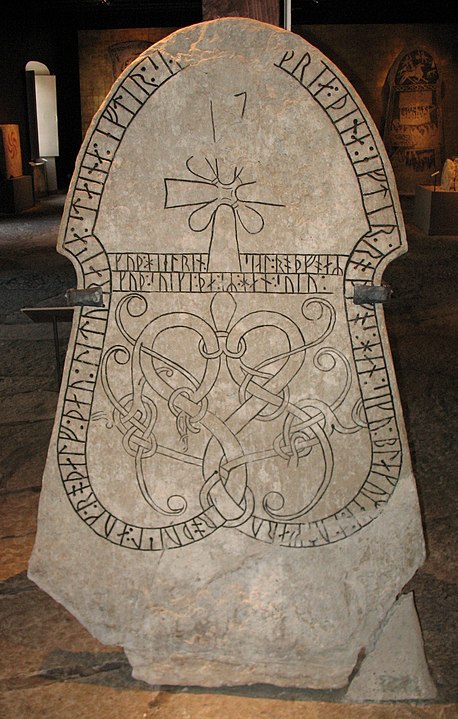
The stone that mentions the Romanians from the 11th century