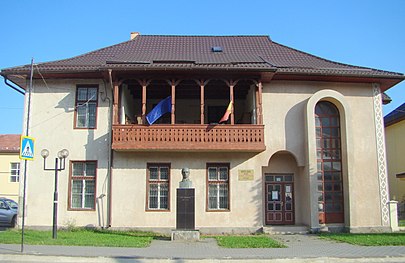
The Maieru Memorial House was founded in 1959 by a group of students led by Sever Ursa, a Romanian teacher whose preoccupation with Rebreanu's work led him to organize a small exhibition of some of the writer's personal belongings. in the school entrance hall. Since 1959, the museum has expanded due to the dedication of its initiator, adding to the efforts of local students and teachers. Today, the memorial house offers over three hundred objects, gaining prestige both as a tourist attraction and as a place where cultural heritage is preserved and revered. The name of the museum has its origins in the metaphorical name used by Rebreanu with reference to Maieru, the village where he spent "the happiest moments of his life". In 2000, the museum received financial support from the Ministry of Education, which was used to install a heating system and to carry out major repairs (flooring, roofing, electricity).
The Liviu Rebreanu and Fanny Rebreanu Memorial House in Bucharest is located in an apartment bought by the writer in 1934 for his daughter, Puia-Florica Rebreanu. She donates the space and its heritage in the desire that they also remember her mother who, except for her acting career, approached the memorial literature, thus giving her the status of a member of the Writers' Union. It was inaugurated in 1995. Price charts (in charcoal, pencil, pen) can be admired in the entrance hall. In the living room there are large-scale paintings of the mother and daughter, works bearing the signature of Camil Ressu. Other fine works of art can be seen in the most important room, the writer's office, works made by prestigious artists of the time (Jean Alexandru Steriadi, Milița Petrașcu, Ion Jalea, Francisc Șirato). In the room where the daughter of the two writers lived, we can admire family photos, some paintings and a beautiful collection of icons, giving the impression of an iconostasis. The largest room of the museum is the living room, furnished with Biedermeyer pieces, which continues the collection of icons, but where we also find a clock in the base, a unique object. In the kitchen, the walls are covered with an impressive collection of ceramics (pieces specific to the Transylvania area).
The Liviu Rebreanu Memorial House in Valea Mare was opened on May 27, 1969, in the house that Rebreanu bought in 1930 and which he owned until September 1, 1944, when he died at the age of 59 years old. On September 3, 1944, he was buried in the church cemetery in Valea Mare, only to be moved to the Bellu Cemetery in Bucharest. In Valea Mare, he would write for the most part, alternatively with his home in Bucharest, the novels Răscoala, Jar, Gorila and Amândoi. The memorial house evokes the writer's personality through Liviu Rebreanu's personal belongings, manuscripts, photographs, letters, books, etc.