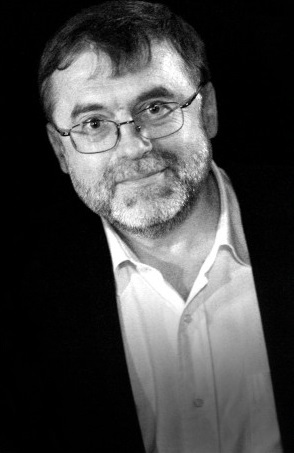
Matei
Vișniec
Vișniec
He was born on 29 January 1956 in Rădăuți, into a family whose land had been confiscated by the Communists. From an early age, Matei Vișniec noticed that the ideology he was forced to adopt both at school and in his personal life did not correspond to his values, so he drew inspiration from this difference between reality and appearance and transposed into many of his plays elements of the absurd he came into contact with in reality.
Between 1965 and 1975 he attended school and high school in his home town, and began publishing his first poems in the school magazine, ”Lumina”, and then in the magazine Cutezătorii. At the age of 16 he made his national debut in the magazine Luceafărul.
The circus show on tour in Rădăuți, full of colour, on stage, live, awakened his taste for theatrical performance, and the atmosphere of his hometown during his childhood inspired the idea of the play Angajare de clovn.
In September 1987, he was granted a tourist visa for a trip to France and Greece, and in Paris a French literary foundation (La Fondation pour une Entraide Intellectuelle Européenne) offered him a literary scholarship. While in Paris, his play "Horses at the Window" is banned from the Nottara Theatre in Bucharest, the day before its opening night, so at the beginning of October he applies for political asylum in France.
Between October 1987 and August 1988, the author lives the first months of exile in Paris, meets prominent members of the Romanian emigration (Monica Lovinescu, Virgil Ierunca, Virgil Tănase, etc.), takes intensive French language courses, for a month and a half lives in a hostel for immigrant workers, then is housed in a hostel of the humanitarian organization "Secours Catholiques". During this time, he frequents Parisian theatres intensively and begins translating his own plays into French.
From August 1988 to October 1989, he lives in London where he works as a journalist for the Romanian section of BBC RADIO, where he has a beneficial contact with Anglo-Saxon theatre and writes a play in English - The Pit.
In October 1989, he resigned from the BBC to begin his doctoral studies in France. A two-year fellowship allows him to live at the Cité Internationale Universitaire in Paris and write a thesis on "Cultural Resistance in Eastern Europe under Communist Regimes". He immediately obtains his first French degree - DEA (Diplôme d'Etudes Approfondies); at the same time, he starts writing plays directly in French. After that, he devoted himself to the theatre and to journalism at the Romanian section of RADIO FRANCE INTERNATIONALE. He began a rich activity as a journalist. His life can only be seen through the prism of the cruelty of the "latest news" that he has to transmit to the public at the radio station where he is employed in Paris (RFI).His literary creation finds inspiration here, for example in the war in Bosnia (Du sexe de la femme comme champ de bataille dans la guerre en Bosnie), but there is also the danger of not creating, of not having other subjects, which he has always overcome.
Since 1992, Matei Vișniec's plays have been performed abroad: Les chevaux à la fenêtre, in France at the Théâtre Les Celestins des Lyon, directed by Pascal Papini, and Petit boulot pour vieux clown, at the Bonn Theatre Biennale. Subsequently, 20 of his plays were performed in France (Théâtre de l'Est Parisien, Théâtre du Guichet Montparnasse, Théâtre du Rond-Point, Studio des Champs-Elysées, etc.) Matei Vișniec is the second Romanian playwright after Eugène Ionesco to succeed in the select and extremely conservative world of French theatre. Since 1992, he has presented one or more plays at each edition of the Avignon International Theatre Festival, one of France's prestigious theatre festivals and one of the largest in the world.
Although he has moved to France, the playwright retains a close link with his homeland,